See the proof behind every status
A listing is marked sold only when the page says so, and the record quotes the text it relied on. A value the page does not show stays null.
Data infrastructure for ecommerce intelligence
You build the research, pricing or ad intelligence product. vexqo collects the listings, prices, stock and ads behind it from public pages and returns JSON, with the page text that proves each status.
Blocked and failed requests are never billed.
The real page, as our browser loaded it
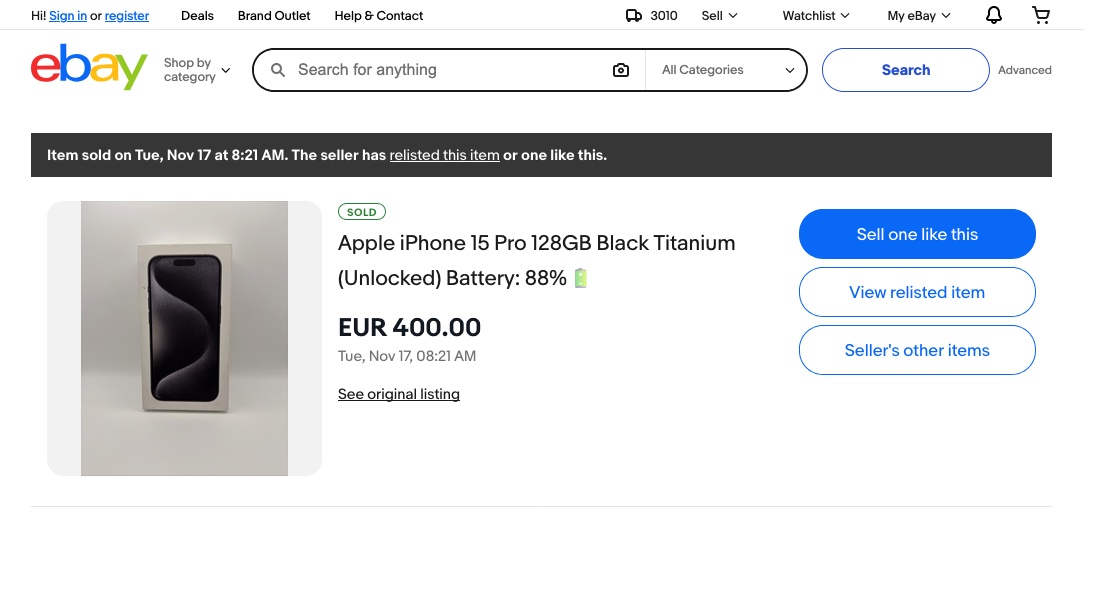
2001.13 sRecorded 17 Nov 2026, 17:14 UTC
{
  "listing_id": "147677702327",
  "url": "https://www.ebay.com/itm/147677702327",
  "title": "Apple iPhone 15 Pro 128GB Black Titanium (Unlocked) Battery: 88%🔋",
  "listing_status": "sold",
  "price": {
    "amount": "400.00",
    "currency": "EUR",
    "type": "final_auction_price"
  },
  "bid_count": 28,
  "availability": "unavailable",
  "stock_quantity": null,
  "source_scheduled_end_at": "2026-11-17T16:21:08Z",
  "ended_detected_at": "2026-11-17T16:22:26.905126Z"
}Marketplace listings and ad libraries today, with more sites on the way. Tell us the one you need next.
vexqo sells data and has no analytics product of its own, so it does not compete with what you build on it.
Listing price, bids, seller, category, condition and item specifics, checked again on the schedule you set.
Price and availability for the products you track, with a change event when either moves. We add retailers from a sample of your own URLs.
Public ad library records with every creative card, the run dates and the advertiser details, plus the product each ad links to. See the Meta Ad Library API.
Sold and ended status quoted from the page, the price in its original currency and the condition text, so every sold price links back to its source. See the eBay sold listings API.
Collecting ecommerce data yourself breaks in four places. Here is what vexqo does about each.
A listing is marked sold only when the page says so, and the record quotes the text it relied on. A value the page does not show stays null.
Each event lists the fields that moved, with before and after values. A check that finds nothing new sends nothing.
Marketplace listings, product pages and ad libraries come through one API and one key. A new site is a request to us, not a new integration for you.
Blocked requests, retries and failed parses are never billed. You pay per verified result and set the monthly cap.
Ask for one record at a time through the API, or hand over a list and receive a Feed of what changed.
Send a URL or ID. One verified record comes back with price, availability, shipping, attributes and images.
A listing is marked sold or ended only when the page says so, and the record quotes the text it relied on.
Ads from a public ad library page, with every creative card, the run dates and the advertiser details.
We follow the ad's link to the retailer page and return the price, size and SKU of the variant the ad selected.
Hand over a list of IDs and a schedule. The target is a successful check on 95% of them inside every 60 minutes.
Each event names the fields that changed, with before and after values and a stable ID, so a repeat is safe to ignore.
Discovery by category. Listings with a verified creation date are kept apart from ones we saw for the first time.
IDs checked, freshness, failures, duplicates removed and field completeness, in a daily report you can audit.
Something else? Write to [email protected].
No. vexqo reads public pages, logged out. It is web scraping, with no approval from the sites it reads and no claim of one. Check that your intended use fits their terms.
Software teams that build analytics on ecommerce data, such as marketplace research tools, pricing and digital shelf platforms, ad intelligence tools and price guides. If you only need reports on your own store's orders, vexqo is the wrong tool.
No. vexqo sells data through an API and a feed. It has no analytics product, so it does not compete with what you build on the data.
Keep what works. Pick one source or one category where your coverage or freshness falls short. We send a sample from your URLs, and you compare it with your own records before any pilot.
Today, eBay listings through the eBay sold listings API and public ad records through the Meta Ad Library API, including the product pages those ads point to. More sites are coming, and we add them on request, starting with a sample from your own URLs.
Prices are quoted per source, per 1,000 verified results. Blocked requests, retries and failed parses are our cost, and you set the monthly cap.
The pilot target is a successful check on 95% of your IDs inside every rolling 60 minutes. The daily report shows the share we reached, not the requests we tried.
It stays null and the record says why. We do not turn an unknown quantity into zero or a first-seen time into a creation date.
From the page. A listing is marked sold or ended when the page says so, and the event carries that text. An error or a missing search result is not a sale.
Records hold listing data and the public seller name. Buyer details, seller contact details and unrelated personal data are left out.
Request access with the sites and volume you need. We reply with a sample from your URLs and a scope for a pilot.
Tell us the sites and the volume you need. We reply with a sample of what we extract from your URLs, the gaps marked, and a scope for a pilot.